Intel Xeon 6th Gen Processors: Comprehensive Technical Overview

Views : 509
Update time : 2025-12-10 22:05:28

The Intel Xeon 6th generation processors have undergone transformative changes. This analysis focuses on the two distinct codenames and core architectures: Granite Rapids and Sierra Forest, featuring P-cores (Performance cores) and E-cores (Efficiency cores) respectively.
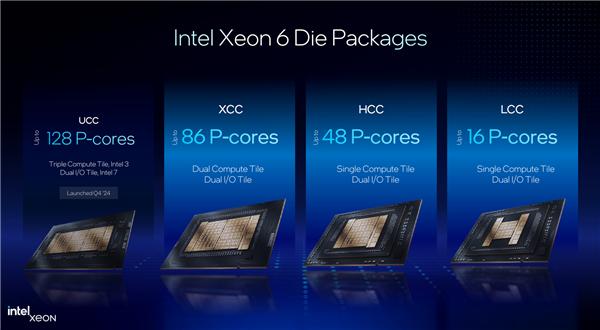
Naming Convention Changes

Previous Xeon processors were categorized into:

  • Bronze series (3xxx models)
  • Silver series (4xxx models)
  • Gold series (5xxx/6xxx models)
  • Platinum series (8xxx/9xxx models)

The 6th generation simplifies this with:

  • Granite Rapids and Sierra Forest codenames
  • P-core and E-core architectures
  • New numbering system: 6900/6700/6500/6300 series with P or E suffixes

Key Differences Between Granite Rapids and Sierra Forest

P-core vs E-core Characteristics:

  • P-cores excel in single-thread performance and support hyper-threading
  • E-cores optimize for multi-core parallel processing without hyper-threading

Enhanced Expansion Capabilities:

  • 6900 series (both P and E variants)

    • Single socket: 96 PCIe 5.0 lanes
    • Dual socket: 192 PCIe 5.0 lanes
  • 6700 series

    • Single socket: 136 PCIe 5.0 lanes
    • Dual/multi-socket: 88 lanes per socket

Model Breakdown

  • 6900P series (e.g., 6980P)

    • High-end market
    • Up to 128 cores
    • Ideal for data center VMs and containers
    • 72-128 core configurations
    • 400W/500W TDP
    • Core count doubles previous generations
  • 6700P series (e.g., 6776P)

    • Cloud computing and high-density environments
    • 8 memory channels (vs 12 in 6900P)

Important Notes

  • Significant socket changes require specific motherboards, limiting CPU interchangeability
  • E-core processors no longer support hyper-threading
  • P-core TDP reaches 500W, surpassing many GPUs
  • Intel no longer provides baseboards, complicating OEM motherboard development
  • AMD's Turin platform development is progressing faster due to Intel's architectural changes
Related News